YOU CAN’T BE SIRIUS !

In our travels we see amazing boats of every size, shape,
and design. This one called “Sirius” looked a bit like the Beatles "Yellow
Submarine"! Believe it or not, people go around the world in things like
this!
THE UNITED STATES OR LIBERIA?

In a previous blog Cathy mentioned about the number of
Turkish, Greek, and Russian boats that some how are "registered" in
the United States, and fly American flags. This is obviously some kind of
tax dodge? Most of the boats seem to be registered in "Delaware".
EPHESUS AT LAST!
After a couple of hundred miles from Finike we reached Kusadasi, the closest town to safely leave the boat. We decided to check into the Kusadasi Marina for the night and visit Ephesus the following morning.
It cost something like 70 euros to take a taxi from Kusadasi up to the site. We caught the local dolmus for 10 TL and got off on the main road and walked the last two kilometers to the site.
THE EPHESUS SITE
Ephesus was the Roman capital of Asia Minor and is steeped in history. St. Paul, St. John, The Virgin Mary, and Alexander The Great have all been here at one time or another!The city used to be served by a harbour at the end of the main street leading up to the theatre. Over time the harbour silted up and left Ephesus about 8 Km (5 Miles) inland from the sea.

[Cathy looking at an areial view of the site showing the old harbour]
Ephesus must have been an awesome sight to
sailors and visitors. When they arrived they would dock their ship in the
protected harbour to unload their goods. They would then pass through the
massive gate opening on to one of Ephesus' wide white marble streets lined
with torches for more than a quarter of a mile to the huge theatre at its end.

We could not walk down to the ancient harbour as the street was roped off to protect two nesting storks nesting on top of one of the columns at the harbour end of the street.

There was a brief rainstorm while we were there which made the white marble streets glisten, as they must have once shined in the 7th century when they were first laid.

The Ephesus site in huge and still largely unexcavated. We
did a complete circuit around the site following its marble streets out to the
edges of the city. Historians have calculated at its height the population of
Ephesus was around 250,000 making it one of the largest cities at its time in
the Mediterranean.

The site is littered with massive columns and fragments of the ruins. As there never seem to be any stone masons tools in the museums it is quite awesome that there was so much stone carving. For example, how on earth did they start out with a quarried lump of marble, shape it, and then turn the spiral grooves on the column in the picture above with such precision? This column is some 500 CM in diameter and this piece alone probably weighs more than a ton!

Sometimes if you look carefully, you can discover a gem in the ruins off the beaten track. Above is a game board carved into a large stone. It is easy to imagine youngsters gathered around it throwing a bone die and moving their markers around the board.

The sun did come out eventually!
THE EPHESUS THEATRE

The Roman theatre is the largest in the Mediterranean. It
seated more than 24,000 people.
St. Paul (with St. John’s help) is supposed to have
stood at the highest point in the eastern corner and “mass baptised” 40,000
assemble Ephesians.
The theatre is still very much intact and is an amazing feature of Ephesus.

Cathy, taking in the staggering size of the theatre. It is
hard to imagine what it was like when filled to capacity
THE CELSIUS LIBRARY

This was once the third largest library in the world after Alexandria and Pergamon. It is said to have contained over 12,000 scrolls in its collection of writings.


Cathy is looking down on some of the ruins in front of the
famous library.
EPHESUS PLUMBING

Ephesus had a very sophisticated system of drains, sewers, and fresh water delivery. Everywhere on the site there are drains and partially exposed pipes of the ancient water works.

No ISO standard sizes here! Each pipe would have been made from clay and joined with cement.

These pipes are carved from blocks of stone and were used to carry fresh water via a siphon system from miles away from Ephesus. We have seen this type of pipe before (but much larger) ‘in the wild’ as part of an aqueduct system between Kalkan and Patara.

These are the Ephesus public toilets! Just in front of the
town Brothel. The waste was carried away by a constant flowing sewer system
about six feet below the toilet seats. A great place to sit and chat with your
neighbour!
THE TERRACED HOUSES


This is a photo above is of the site BEFORE the building was constructed. Note there is an excavated area on the left of the photo. To the right is the unexcavated area that will be covered by the new building. Earthquakes caused the hillside to cover and preserve the houses in the unexcavated area.

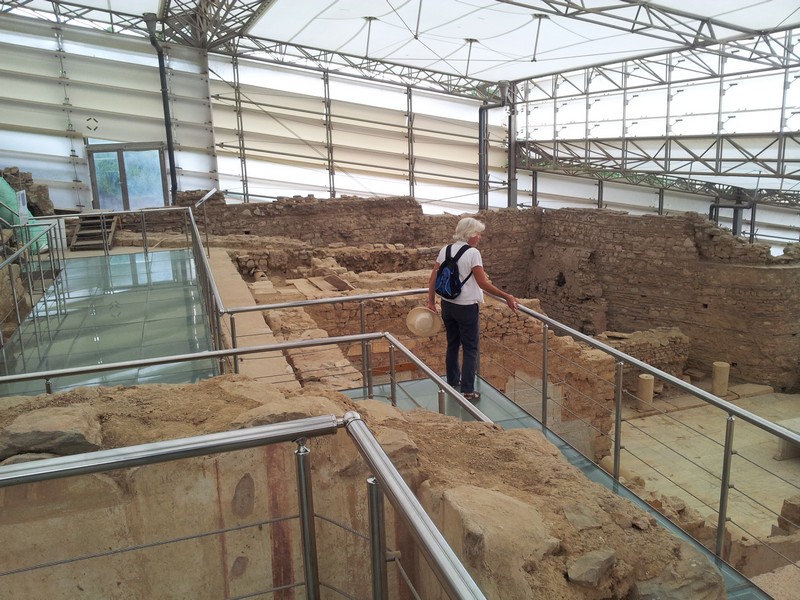
This is a photo of inside the new building. There are extensive glass catwalks that overlook the excavations below.


The glass walkways let you look down at the site below and what you see really brings to life what it must have been like in the lives of the rich Romans that lived here. Simply amazing! This is a Turkish Pompeii.

Looking down on to an internal courtyard. Note the fine mosaics. Many of the rooms had under floor heating (Hypocausts) and running hot and cold water.

Here archaeologists are piecing the fragments of the
plastered ceiling of the early Christian Basilica together to recover the
paintings that were on the ceiling brought down by past earthquakes.

Look at that woman over there!
OMG, it's Cathy climbing on top of precious
ancient ruins to retrieve white mulberries from the tree! How embarrassing!
and FINALLY...
EPHESUS? WILD HORSES COULDN’T DRAG US AWAY…AND THEY ALMOST DID!

A last bit of excitement! While waiting to catch the dolmus back
to Kusadasi, there was suddenly a thundering of hooves. From around the corner someone’s
horses had escaped and were on the run.
[Needless to say, Leighton grabbed the halter of the nearest horse, swung up and riding bareback, caught the other horses...] Yeah, right! Leighton doesn't DO runnaway hay-burners!
THE SAIL TO TEOS
The next morning we cast off from Kusadasi at 08:30 and arrived in Teos marina just after 3 PM. A sea journey of about thirty five nautical miles.
When we docked Makarma in the assigned berth we met a delightful Turkish resident of Teos on the boat next door who was taking his family out for a sail. Once we got settled, he told us that there was the weekly slow food fair in town where people bring and sell homemade food. Off we went!
THE TEOS FOOD FAIR

A family affair. Mum, daughter and grandmother making gozleme.

Here’s granny cooking out lunch!

We stocked up on various freshly made goodies for the boat. This bottled fruit in syrup is a real treat.
THE TEOS LIGHTNING STORM
We’ve been playing cat and mouse with the weather, trying to get as far north as possible before the "Meltemi" - a strong summer wind that blows relentlessly from the north. The Meltami can make a northward passage almost impossible.
We were pleased to find a local weather station at Kusadasi to give us a more up to date and accurate forecast for the next stage of our journey.

We were both pretty tired from the sail up to Teos and after the food fair and a brief tour around the town we turned in about 9:30 PM. We both fell sound asleep in no time.
At 3:30 AM, there was a flash and a very loud explosion just outside the boat. We thought a bomb had gone off in the marina.
We looked outside and there was nothing. No wind. No rain. Just dead still. Then there was another flash and this time it was obvious. A blinding bolt of lightning struck the higher ground just outside the Marina. Then another. Each one was followed by a deafening boom!
We have never experienced an electrical storm quite like it. It just came out of nowhere. Lightning physically hitting objects and the ground all around the marina. Sparks flying in the air. Then came the hail. It was so violent we thought it was going to shatter the hatches. There was such a roar inside the boat we could hardly hear each other speak.
All the time more and more lightning with violent crashes of thunder. For a while the flashes were so close and bright that Leighton had to put on sunglasses to be able to keep a lookout outside.

The following morning the repair crews were out replacing
wires that had been vaporized in the early morning blitz. It was certainly an
uncomfortable feeling to be sitting under a forty-foot high metal mast, but
other masts were higher and it looked like a boat further down in the marina
may have been struck. We were safe and lucky to be OK.
It is a good thing that sailors have short memories.
THE EXPEDITION TO FIND ANCIENT TEOS
Despite having had very little sleep during the lightning storm,
the next morning after breakfast we set off on a hike to try and locate the
ancient town of Teos.

We managed to get past a large unchained dog that occupied
the middle of the road and after about 2 KM we saw some signs that directed us
to various parts of the site.

There was a line of ancient olive trees that judging from
the size of their trunks were clearly planted here several hundred, perhaps
even a thousand years ago. This tree has seen a lot of history and is still
going strong.

Unlike Ephesus, there was physically very little to see of
the site in the way of ruins as they were still buried waiting to be excavated.
However, Cathy spotted an unusual stone that we thought might have been an
early “Spec-Savers” store, but more likely an altar stone where animals were
sacrificed and the channels around the circles were to drain away the
blood. As it was once in the temple of
Dionysus here it could also have been used for pouring libations of wine.
Next stop…?


