NAXOS – OUR VISITORS DEPART

After Brian and Marion's departure (2nd of October) on the Blue Star ferry to Athens to catch their flight to the UK - the Aegean weather decided to get rough. It started with a distinct change in the wind from "breezy" to "blustery". The temperature dropped and winds were either too strong or from the wrong direction to continue our journey towards Crete.
With only a tantalising 116 nm to go, we were starting to wonder if the Aegean weather was going to cooperate. In the end it would be a total of ten days before Makarma could finally leave Naxos.
“THE MOST DANGEROUS EQUIPMENT ON A SAILBOAT IS A CALENDAR”

One morning at 06.30 we were brought out on deck by a loud thump and our Swiss neighbour swearing in German! A 54 foot charter boat trying to leave the harbour had lost control in the wind and was blown sideways on to our quay and across four boats. Luckily we were spared damage by being a few inches shorter than our neighbours on either side.
The Aegean weather conditions can prove dangerous for inexperienced crews trying to get their charter boats back to base to avoid payment of additional “late return” fees.

The strong winds also wreaked a bit of havoc on land as well, cutting off the Naxos electricity supply - the marina was without electricity for a while but we were able to keep Makarma’s lights on using our solar panels and batteries.
A LUCKY BREAK?
Our fresh water pump sprung a leak while we were waiting out the weather. We carry 750 litres of fresh water onboard. It is a pressurized system so if the cracked plastic coupling had completely ruptured it would have pumped all our fresh water into the bilge!

Water in the islands is very precious. We replaced the faulty coupling with a metal one and grafted on an external one-way valve that will get us to Crete. Ho hum, I was looking forward to having to ‘survive’ by drinking beer from the stores cupboard…
THE RUN FOR MIRSINI (SKHINOUSA ISLAND)
After ten frustrating days in Naxos the wind eased and went westerly enough to allow us to make a move at last. Our objective was a small anchorage in the harbour at Mirsini on the island of Skhinousa, south east of Naxos.

As the only boat at anchor in Mirsini we had a wonderfully peaceful night although we were somewhat surprised when this very large Blue Star ferry arrived at the harbour’s tiny quay to drop off passengers early in the following morning!
PASSAGE TO SANTORINI
The strategy of moving to an island southeast of Naxos paid off as the next day’s easterly wind allowed us to sail close hauled for Santorini.

[Approaching the volcanic island of Santorini]
Santorini (or Nisos Thira as it is called by the locals) is unique. The “island” is actually the rim of an active volcano. The caldera is some 10 km in diameter! The caldera is too deep to anchor in (unless you have a thousand feet of chain on board) – so we headed for the south tip of the island and Vlikhada Marina. The winds favoured sailing down the east side of Santorini and under the site of the ancient city of Thira.

[Vlikhada Marina on the south end of Santorini]
Aside from the approach to the harbour being complicated and poorly marked, the entrance to Vlikhada marina silts up and it was uncertain that Makarma with her 2m draft would be able to get in. With Cathy conning on the bow, we managed to negotiate the sandbar with less than 2 inches of water under the keel! Great fun after a long journey.
The weather window for sailing onwards to Crete closed shortly after we arrived. It again looked as if it would be several days before we could sail again, so we decided to hire a car and explore the island.

The edge of the Santorini caldera rises almost vertically 1000 feet out of the sea and is just as deep under the water. The view over the edge from another ten feet forward…

The landscape of Santorini is a very stark – scorched earth, black sand beaches, and vertical drops down into the caldera. Horizontal bands of black volcanic rock mark the past history of violent eruptions.

This is looking out toward the centre of the caldera. The closest island is Palea Kameni (Old Kameni) and in the distance is Nea Kameni (New Kameni). As the names suggest, Nea Kameni is the latest island to appear from volcanic eruptions. These “islands” are actually cooled lava plugs that are capping the core of the volcano.

Very large cruise ships hold on-station (too deep to anchor) while tenders shuttle the tourists ashore at the base of the main town of Thira (or Fira if you are Greek), where they ascend the last 1000 feet to the top by riding on a mule or taking the cable car.

Thira is a real jewel box of a town to look at - but it is a tourist hell! The small pedestrian walkways are filled with hundreds (maybe thousands) of people shuffling along taking photos of the view and buying postcards in the tourist shops.
Thira is also noted for its very over-priced tourist cafes (e.g., 14 euros for two small bottled beers and a toasted sandwich) that no self-respecting Greek would ever frequent in a lifetime. Not our scene at all.
IA - THE REAL JEWEL OF SANTORINI
At the very northern tip of Santorini is the town of Ia. It is a good 10 km from Thira, so not many trippers make the time to go there. This is good news as the alleyways are far less crowded with tourists and the place is delightful.

Ia is the posh end of Santorini and boasts very expensive private villas with lots of infinity swimming pools overlooking the caldera.

The town is very pretty and clings to the top of the hill like snow. There are several old windmills and the ruins of a Venetian fort on the far point overlooking the sea.

[A gulet under sail in the caldera glides past Ia]
The views are spectacular - but having seen the pictures of Mount St Helen when it blew - I think you have to be a bit crazy to live on the edge of an active volcano!
THE IA MARITIME MUSEUM
Ia has a small but excellent Maritime Museum, which contains many interesting artefacts. Its collection of odd bits and bobs seem to cover anything nautical from Columbus to Cook.

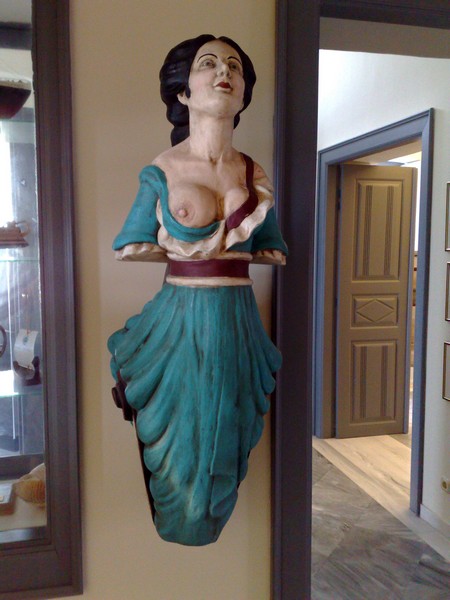
Leighton thought this ship’s figurehead bore a striking resemblance to Margaret Thatcher(!).

There was an amazing collection of old photographs of Santorini and the maritime activities that went on there.

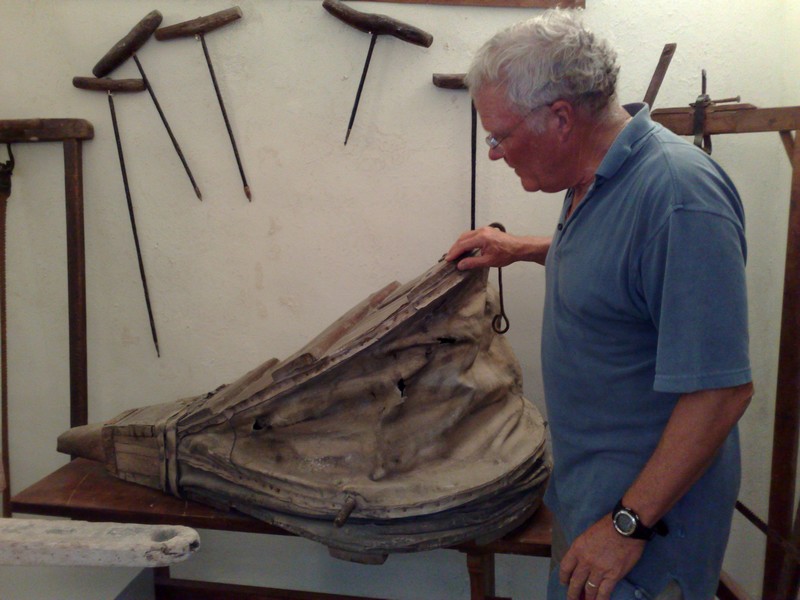
There was also a very interesting collection of ship building tools. This bellows was used to get the coal fires burning on one of the early steam-powered vessels that took over from sail.
THE BIG BANG
The Santorini eruption is credited with wiping out the Minoan civilization in Crete (1647 – 1628 BC). When the volcano erupted, cold seawater rushed into the superheated crater and the explosion that followed was estimated to be some five times that of Krakatoa. Crete is only 60 miles further south and it is believed a 300 foot tsunami resulting from the eruption wiped out all the coastal towns on the northern side of Crete.
AKROTIRI AND “ATLANTIS” ?
There is Neolithic evidence of human occupation on Santorini that predates 3000 BC.
The Minoans had also settled here. Akrotiri is a complete Minoan city with three storey buildings that were buried under volcanic ash. The site is currently closed to the public while excavation work is underway but we were able to have a brief look at what was going on.

This is the site of the Akrotiri excavations. Glass roofs cover whole Minoan streets. It has been called the “Pompeii of the Aegean” and is classified as one of the world’s most important archaeological sites.
The city was abandoned long before the massive eruption took place – as unlike Pompeii, no bodies were found in the ash and very little jewellery or small personal belongings. This would indicate that the people of Akrotiri had adequate warning (perhaps from earthquakes) and might have left Santorini, either for Crete or further north into the other Aegean islands before the big eruption took place.
Many of the site’s discoveries are on display in the Thira Archaeological Museum and others are in Athens.

The “Blue Monkey Room” is an example of one of the recovered murals at the Akrotiri site. Complete rooms have been discovered brightly decorated with painted wall murals. These are giving archaeologists and scholars new insights into the sophistication of the Minoan civilization, culture and daily life.

The Minoans were creative potters and many examples are still being recovered from the site at Akrotiri.

Some of our favourites were the elegant bird-shaped pitchers like this one, decorated with bright colours and images of flowers, birds and dolphins.

It has been possible to make plaster casts of wooden objects such as this elegantly carved three-legged table that would have been burned up in the volcanic ash.

The Minoans were also very skilled in the art of metal craft as illustrated by this gold ibex used as a votive offering.

There is also the mystery of Minoan writing. Here are samples of “Linear A” an un-deciphered Minoan script on clay tablets.
ANCIENT THIRA
This was the highlight of our trip to Santorini.
On the southeast side of Santorini lie the extensive ruins of the ancient city of Thira. On foot it takes well over an hour to climb the twisting path the 1000 feet to the top. We drove up a precipitous road almost to the top, and then walked out to the point.

The site overlooks Santorini’s airport – and it was a bit surreal to look down on the top of 737s coming in for a landing!

The hilltop site of ancient Thira was occupied by Minoans, Greeks, Romans, and Venetians. There are layer upon layer of thousands of years of occupation.

The site occupies a fantastic vantage point overlooking the sea in both directions. We sailed along this coast and could see the ruins on top of the ridge from the boat.

It was a real treat to come across an object like this one below. A bronze dish at the entrance of a temple fixed into a stone with lead - perhaps used like a vessel for holy water(?). It is fascinating to think this object was in common use in some ritual over 3000 years ago. It is almost magical to be able to touch it as many might have also done before me.

AND FINALLY…
THE BOUTARI WINE TASTING
We visited the Boutari winery for a taste of some of the some of the unique Santorini wines. Cathy was able to reminisce about an earlier boat trip to Santorini to collect Vinsanto dessert wine for friends on Naxos.

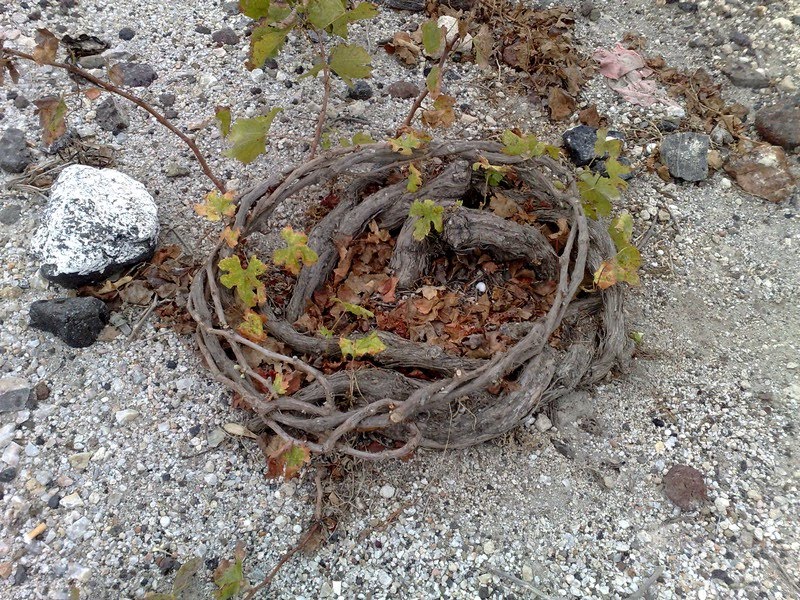
The traditional Santorini grape vines are pruned and trained into a circular “basket”. This provides the vine with its own support, allows air to circulate around the grapes, and captures moisture. Some of these baskets are several hundred years old. The vineyard’s biggest problem has been people cutting off the baskets in the winter (thinking the hibernating vine was dead) and using it as a decoration!
AND OUR TOP AWARD GOES TO…
Santorini’s only “Slow Food Restaurant” and their hand carved wooden sign! 10/10.

THE FINAL LEG OF THE JOURNEY
We are keen to complete our journey for this season. Winds willing, we will soon set sail on the final leg - the 70 miles from Santorini to our winter quarters in Agios Nikolaos, Crete. Although it is less than the distance of an overnight English channel crossing, we have learned to treat the Aegean Sea with great respect.


 Bull jumper fresco from Knossos